 Manager
In today’s digital world, every business has a public face — whether it chooses to or not. The only real question is who controls that face.
For many small companies, the answer is: platforms do. Facebook, Instagram, Google Maps, marketplace listings. These feel convenient, even sufficient. And in the short term, they often are. But convenience is not the same as control, and visibility is not the same as identity.
A website is the only place where your business speaks in its own voice, on its own terms, without filters, algorithms, or distractions. It is not just another marketing tool. It is where you define who you are — not where someone else defines you.
And whether you build one or not, that choice sends a message.
People Don’t “Find” Businesses Anymore — They Verify Them
Before a customer calls, messages, or visits, they check. They search your name. They look for proof that you exist, that you are reachable, and that you take yourself seriously.
They want to see:
- What you do
- Who you are
- How to contact you
- Whether you look real
A website answers all of that in one place. Cleanly. Permanently. Without forcing people to scroll past unrelated content or advertisements.
Without a website, your business looks like a fragment: a profile page here, a review there, a phone number somewhere else. It may still work — but it doesn’t feel whole.
And perception matters, especially for small businesses.
Social Media Is Not Your Identity — It’s a Borrowed Stage
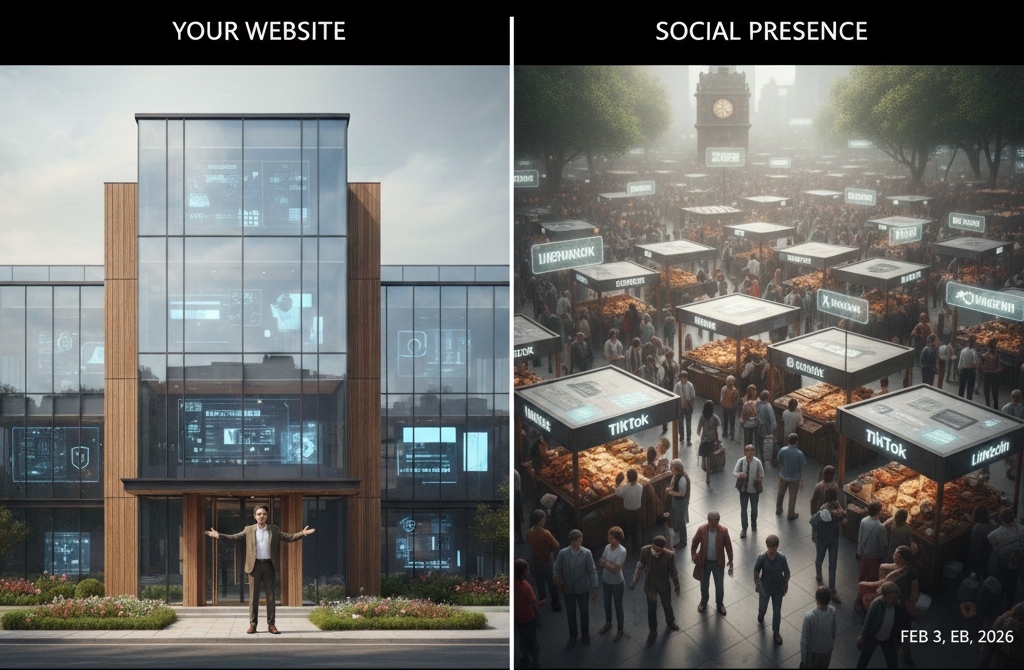
Social platforms are useful. They are loud, fast, and social. But they are not neutral.
They decide:
- How your content is shown
- What is hidden
- What is removed
- What is promoted
- What is buried
Your business appears inside someone else’s interface, surrounded by other brands, messages, and distractions. Your story competes with memes, ads, and trending videos. You don’t control the context.
A website is different.
It is not a feed.
It is not a timeline.
It is not a marketplace.
It is a space where your business stands alone.
This is where you choose:
- What matters
- What comes first
- What people should understand about you
That is not about technology. It is about authorship.
Being Small Is Not a Reason to Skip a Website — It’s a Reason to Have One
Many small businesses believe they are “too small” for a website.
In reality, being small makes clarity more important, not less.
Large companies can survive confusion.
Small companies depend on trust.
A website does not need to be big. It does not need to be complex. It does not need to sell online. It only needs to do one job well: explain your business clearly and honestly.
Who you are.
What you offer.
How to reach you.
That alone separates you from businesses that look temporary, vague, or improvised.
A business without a website feels like a business that might disappear.
A business with a website feels like a business that plans to stay.
Your Website Is Where You Set the Tone
On social platforms, your business must adapt to the platform’s style: short posts, trends, reactions, quick impressions.
On your website, you set the tone.
You decide:
- Whether you sound professional or friendly
- Whether you focus on craft or price
- Whether you emphasize service or speed
- Whether you tell your story or stay practical
This is not cosmetic. It shapes how people interpret you.
Two businesses can offer the same service.
The one with a website feels intentional.
The one without feels incidental.
That difference influences decisions, even when people don’t consciously notice it.
Not Having a Website Is Also a Statement
Choosing not to have a website is still a choice. And like all choices, it communicates something.
It may say:
- “We rely on platforms to explain us.”
- “We are hard to find.”
- “We don’t need a stable home online.”
- “We are not invested in how we appear.”
That may not be what you intend — but it is how it can be read.
In business, silence is interpreted.
Absence is interpreted.
Gaps are filled by assumptions.
A website prevents that. It replaces guesswork with definition.
This Is Not About Trend. It Is About Ownership.
A website does not replace social media. It anchors it.
Social channels can point to your website. Listings can link to it. Ads can lead to it. Messages can reference it.
It becomes the fixed reference point — the place where your business is fully itself, not just a profile among thousands.
You do not need a big budget.
You do not need complicated features.
You do not need constant updates.
You only need a place where your business exists as a complete idea.
In the End, It Really Is Your Choice
You can let platforms describe your business for you.
You can let search results piece it together.
You can let customers guess.
Or you can decide to speak for yourself.
A website is where you tell the public about your business, your way.
Not louder.
Not trendier.
Not flashier.
Just clearer.
And in a crowded digital world, clarity is not optional. It is what separates the businesses people trust from the ones they scroll past. Talk to us today and we can help you plan your digital presentation